Create New Content
Start new content from a structured workflow instead of a blank page. A guided creation path helps teams keep consistency while still leaving room for creativity.
a content operations hub for generating, organizing, and reusing content assets so the team can move faster without losing consistency
Content Library is a content operations hub for generating, organizing, and reusing content assets so the team can move faster without losing consistency. In practical terms, it gives your team a clear way to understand the signals that matter most for modern discovery, whether that discovery happens in search, in an AI assistant, or in a blended answer experience. Instead of guessing how visibility is changing, you get a structured view of where the opportunity sits, what is already working, and what still needs stronger evidence or cleaner execution. That is what makes the feature useful not just for reporting, but for active decision-making across marketing and product teams.
Inside SAGA, content library is designed to turn raw platform output into an editorial or operational decision. That means the feature does more than show you a score or a list. It helps you decide what to fix, what to expand, and what to track next so the work feels connected to business outcomes rather than isolated reports. The result is a repeatable way to move from observation to action without losing the strategic context behind the data.
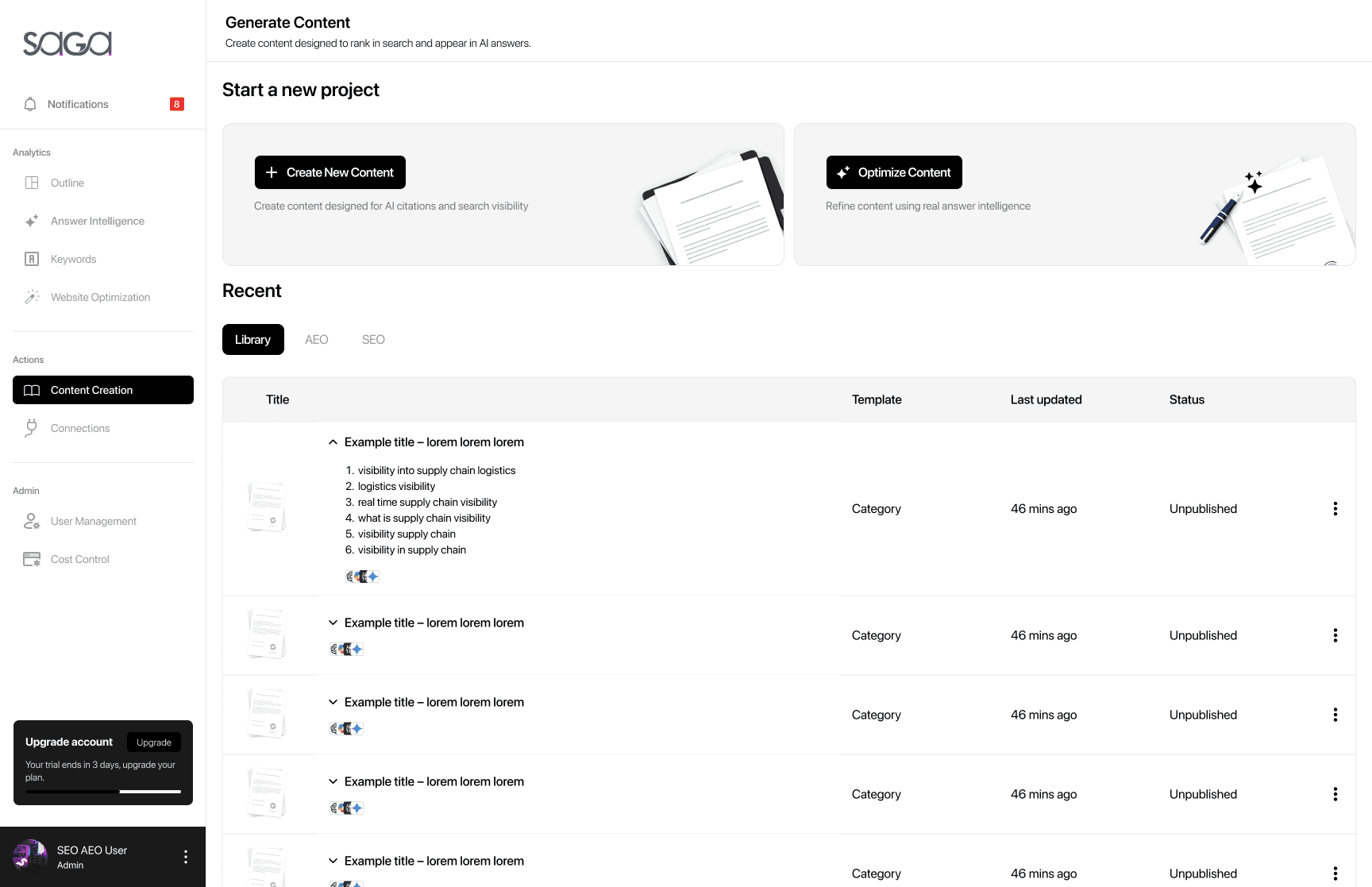
Content Library matters because buyers now move between search engines, AI assistants, and answer-first interfaces without thinking about the boundaries between them. If your brand is invisible or weak in one of those environments, the gap can affect awareness, trust, and demand even when classic SEO metrics still look acceptable. That makes the feature relevant for both growth teams and leadership teams that need to understand why market visibility changes even when traditional analytics appear stable.
For teams working in content studio, the difference between a useful program and a noisy one is usually clarity. A strong content library workflow helps you see where you are winning, where competitors are pulling ahead, and which pages or prompts deserve immediate attention. It also creates a shared language between content, SEO, and operations so improvements can be prioritized without long back-and-forth meetings.
Content teams often create assets in isolated workflows, which makes it hard to reuse ideas, research, or drafts later.
Without a library, there is no central place to review what has already been produced or what still needs to be created.
Teams may have strong ideas but weak operational structure.
Content Library in SAGA solves the analysis problem by pulling the relevant signals into one repeatable workflow. That keeps the team from toggling between exports, screenshots, spreadsheets, and point tools just to answer a simple question about performance. The platform turns the output into a shared source of truth that content, SEO, and leadership can understand together, which lowers the friction of turning findings into actual tasks. It also helps new teammates ramp faster because the logic of the review is visible in one place.
The other advantage is prioritization. Instead of asking the team to improve everything at once, SAGA helps you focus on the pages, prompts, sources, or assets that are most likely to move the result. That creates a more realistic operating model, because small teams can still make strong progress when the next step is obvious. In practice, that means the platform can support both quick wins and deeper strategic work without forcing you to choose between them.
SAGA creates a central home for content assets so the team can move from idea to draft to refinement in one workflow.
The library makes it easier to reuse outputs from answer intelligence and generation features.
This creates a better operating model for teams that produce content at scale.
Each sub-feature below is explained in practical terms so the page can be used as both a product explainer and an SEO landing page.
Start new content from a structured workflow instead of a blank page. A guided creation path helps teams keep consistency while still leaving room for creativity.
Turn research and visibility signals into usable editorial direction. That makes the library more than storage because it becomes a source of strategic content inputs.
Keep work in progress visible so teams know what is approved, in review, or ready to publish. Better organization makes collaboration less chaotic and less repetitive.
Reapply useful structures, findings, or draft components across new content projects. Reuse improves speed while keeping the output aligned with what already works.
A content team wants a central place to manage drafts.
A strategist wants to reuse prompt analysis in a new article brief.
A marketing manager wants better visibility into content production.
A founder wants one place to oversee content assets.
Every feature page includes a table so teams can compare SAGA against manual workflows or disconnected tools.
| Dimension | SAGA | Manual / Point Tool |
|---|---|---|
| Coverage | SAGA gives a unified view of content library across the signals that matter most. | Manual reviews or isolated point tools usually capture only a slice of the full picture. |
| Priority | Findings are organized so the next action is easier to choose and defend. | Generic reports often show issues without making it clear which ones matter first. |
| Collaboration | SEO, content, product, and leadership can work from the same dashboard and language. | Disconnected tools make it harder for teams to agree on the next move. |
| Momentum | You can repeat the workflow as pages and prompts change over time. | One-off analysis slows momentum and makes it harder to measure progress. |
Choose a keyword cluster, target topic, or creative prompt to guide your content generation workflow.
SAGA's AI-assisted studio drafts article outlines, generates high-quality text, or creates supporting images and videos.
Review the generated drafts, check for prompt alignment, and verify that readability and structure match target platforms.
Publish the finalized assets directly, save them to your Content Library, and reuse successful elements for future projects.
Eight FAQs are included on every feature page so the page can answer common purchase, usage, and workflow questions directly.
Get started with SAGA's comprehensive visibility audit and platform-by-platform optimization checklist.