Meta Tag Health
Check whether titles, descriptions, and other metadata are present, clear, and aligned to the page's purpose. Healthy metadata helps search engines understand the asset and can improve click quality.
a structural audit that checks meta health, indexability, and schema readiness so teams can detect the technical issues that block discovery
SEO Structure Audit is a structural audit that checks meta health, indexability, and schema readiness so teams can detect the technical issues that block discovery. In practical terms, it gives your team a clear way to understand the signals that matter most for modern discovery, whether that discovery happens in search, in an AI assistant, or in a blended answer experience. Instead of guessing how visibility is changing, you get a structured view of where the opportunity sits, what is already working, and what still needs stronger evidence or cleaner execution. That is what makes the feature useful not just for reporting, but for active decision-making across marketing and product teams.
Inside SAGA, seo structure audit is designed to turn raw platform output into an editorial or operational decision. That means the feature does more than show you a score or a list. It helps you decide what to fix, what to expand, and what to track next so the work feels connected to business outcomes rather than isolated reports. The result is a repeatable way to move from observation to action without losing the strategic context behind the data.
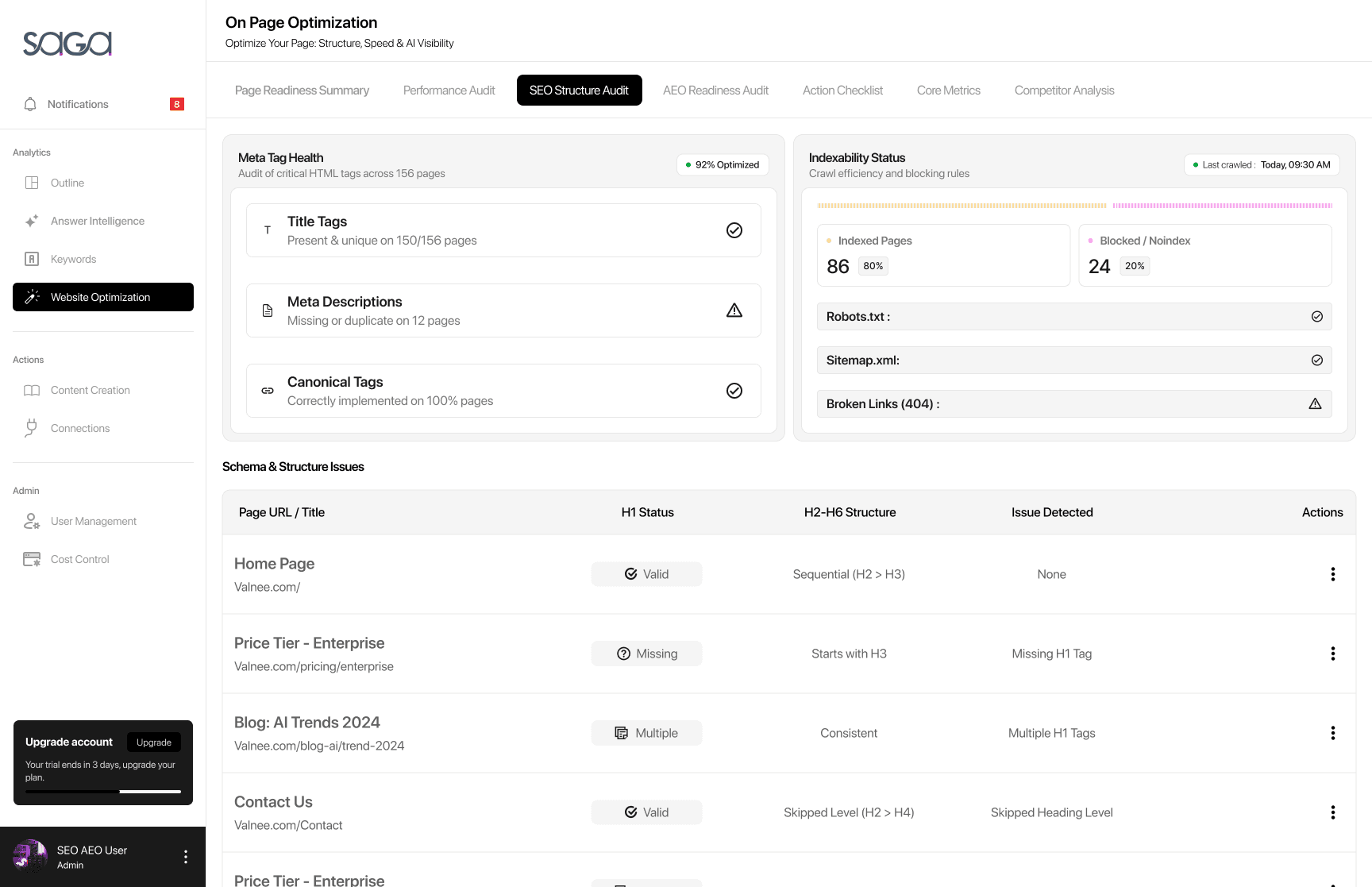
SEO Structure Audit matters because buyers now move between search engines, AI assistants, and answer-first interfaces without thinking about the boundaries between them. If your brand is invisible or weak in one of those environments, the gap can affect awareness, trust, and demand even when classic SEO metrics still look acceptable. That makes the feature relevant for both growth teams and leadership teams that need to understand why market visibility changes even when traditional analytics appear stable.
For teams working in readiness & audit, the difference between a useful program and a noisy one is usually clarity. A strong seo structure audit workflow helps you see where you are winning, where competitors are pulling ahead, and which pages or prompts deserve immediate attention. It also creates a shared language between content, SEO, and operations so improvements can be prioritized without long back-and-forth meetings.
SEO structure can degrade quietly when metadata, indexing rules, or structured data drift over time.
Teams may know a page is underperforming but not know whether the cause is the HTML structure, the metadata, or the indexing setup.
Structural audits are often too technical for content teams to use directly.
SEO Structure Audit in SAGA solves the analysis problem by pulling the relevant signals into one repeatable workflow. That keeps the team from toggling between exports, screenshots, spreadsheets, and point tools just to answer a simple question about performance. The platform turns the output into a shared source of truth that content, SEO, and leadership can understand together, which lowers the friction of turning findings into actual tasks. It also helps new teammates ramp faster because the logic of the review is visible in one place.
The other advantage is prioritization. Instead of asking the team to improve everything at once, SAGA helps you focus on the pages, prompts, sources, or assets that are most likely to move the result. That creates a more realistic operating model, because small teams can still make strong progress when the next step is obvious. In practice, that means the platform can support both quick wins and deeper strategic work without forcing you to choose between them.
SAGA translates structural SEO issues into an understandable review that content, SEO, and development teams can share.
The audit focuses on the most practical signals that affect whether a page can be crawled, interpreted, and surfaced correctly.
Because the output is easy to scan, it can move into a workflow instead of staying trapped in a technical report.
Each sub-feature below is explained in practical terms so the page can be used as both a product explainer and an SEO landing page.
Check whether titles, descriptions, and other metadata are present, clear, and aligned to the page's purpose. Healthy metadata helps search engines understand the asset and can improve click quality.
Verify whether the page can be discovered and indexed the way you expect. Indexability is one of the first things to confirm whenever a page seems invisible.
Detect markup and structural problems that make it harder for search and AI systems to parse the page correctly. This helps teams catch missing context before it affects performance.
An SEO specialist wants to audit a template before rollout.
A developer wants a concise structural checklist.
A content team wants to understand why a page is not indexing well.
A marketer wants to verify the basics before publishing.
Every feature page includes a table so teams can compare SAGA against manual workflows or disconnected tools.
| Dimension | SAGA | Manual / Point Tool |
|---|---|---|
| Coverage | SAGA gives a unified view of seo structure audit across the signals that matter most. | Manual reviews or isolated point tools usually capture only a slice of the full picture. |
| Priority | Findings are organized so the next action is easier to choose and defend. | Generic reports often show issues without making it clear which ones matter first. |
| Collaboration | SEO, content, product, and leadership can work from the same dashboard and language. | Disconnected tools make it harder for teams to agree on the next move. |
| Momentum | You can repeat the workflow as pages and prompts change over time. | One-off analysis slows momentum and makes it harder to measure progress. |
Select the URL of the landing page or article you want to audit for SEO, performance, and AI readiness.
SAGA runs a comprehensive audit of metadata, indexing rules, mobile speed, Core Web Vitals, and structural schema.
Review the distribution of critical issues, warnings, and passed items to see what is blocking your search performance.
Implement the high-impact speed fixes, resolve missing metadata, and re-run the audit to verify your improved health score.
Eight FAQs are included on every feature page so the page can answer common purchase, usage, and workflow questions directly.
Get started with SAGA's comprehensive visibility audit and platform-by-platform optimization checklist.